
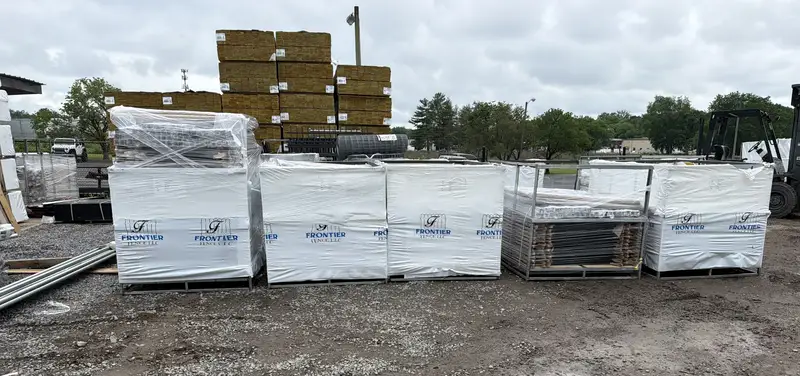
Most wood fences in this region are only as good as the posts that hold them. The face can be stained, capped, and replaced in sections. The post stands in soil or concrete for the life of the run, in a climate that stays wet more often than not. When a treated-lumber rating is vague — when a list just says “treated posts” — the wrong use category is an easy mistake, and it shows up years later as movement at grade.
When you request a wood quote, include the species, the use category, the retention when you have it, and which members actually touch the ground. That gives us a list we can price accurately.
Ground contact is a use, not a marketing word
Pressure-treated southern yellow pine is the workhorse for posts, rails, and many pickets on residential and agricultural jobs in the Southeast. The important part of the tag is the use category, and, when the specification states it, the retention. A post that will be set in soil or concrete should be quoted as ground-contact treated lumber, not as a generic “treated” stick and not as an above-ground rating. Rails and pickets that stay off the soil are often a different use category, and that is fine if the takeoff says so.
Retention figures such as 0.40 or 0.60 pounds per cubic foot appear on many specifications. We will quote them when you require them. They are not a secret grade we apply to every post by default, and they are not something to invent on a residential list if the job does not call for them. If a builder packet or a commercial specification names a retention and whether the stock should be incised, put that language on the quote request so the list matches the packet.
Why posts fail at grade
Wood decay and fastener corrosion concentrate where the post leaves the ground, especially when soil or mulch holds water against the face, or when a hole is a bowl that never drains. A ground-contact rating is necessary and not sufficient. The hole should not collect water, the grade should slope away from the post, and the post length should allow a sensible embedment plus the local frost depth. Confirm frost depth with the authority having jurisdiction. A six-foot face often uses an eight-foot post where a two-foot embedment is enough; deeper frost lines need a longer post.
Concrete does not automatically protect a post. Encasing a post in concrete that traps water at the top of the footing can be worse than a well-drained, compacted setting. Concrete is often counted at two bags per post as a starting point for a typical residential hole. Hole size, depth, and bag weight change the number, and the setting method belongs on the quote if you have a preference.
Species mixes, cedar faces, and what not to substitute
Treated southern yellow pine posts and rails with cedar pickets are a common and reasonable mix, as long as the list says so. Cedar is quoted when the face is highly visible, when a pre-stained finish is part of the package, or when the specification calls for it. It is not a substitute for a ground-contact post. Spruce or other pale softwoods sometimes appear in a specification for pickets or boards; treat those as specification items, and do not assume they can stand in for a post in the ground.
Pre-stained cedar reduces on-site finishing. It still needs a sound post, a sensible cap or trim detail if the design has one, and fasteners meant for exterior treated or cedar stock. Stain or a factory finish can slow weathering of the face. It does not change the use category of the post.
Climate in the Southeast and farther north
Humidity, rainfall, and termite pressure are the usual drivers on Tennessee and Deep South jobs. Clay soils that hold water around a post, and splash at grade from downspouts or pavement, matter as much as the average temperature. Farther north in Kentucky, Ohio, Indiana, and Illinois, frost depth and freeze-thaw at the footing become part of the post-length conversation. If the job sits on a ridge, a wet bottom, or a filled lot, say so on the quote request.
Steel posts are sometimes used with a wood face when the specification wants a steel line or terminal with wood rails and pickets. That is a different takeoff. It can be a good answer in soils that are hard on wood, but it should be written as steel posts plus the wood face, not as a silent substitution.
What to write on the quote request
- Which members are posts, rails, and pickets, and which of them touch soil or concrete.
- Species — treated southern yellow pine, cedar, or a mix — and any pre-stained finish.
- Ground-contact treatment for posts set in the ground, plus retention and incising if the specification requires them.
- Post length or face height, and anything you already know about frost depth or grade.
- Gate posts called out separately, often a size up from the line post.
If you are unsure of the rating on a list you inherited, send the list anyway and flag the posts. We would rather quote a ground-contact post plainly than guess. Request a quote for current pricing, and use the wood product page or the material takeoff if you want a planning count before you write. The rating on the post is still worth a sentence of your own.