
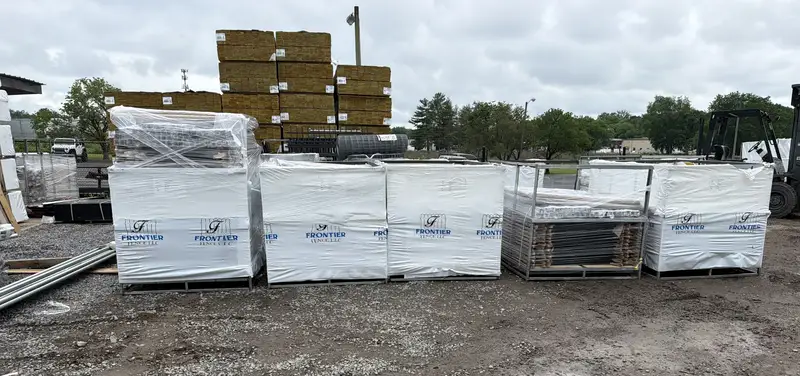
Wood is still the default fence on many residential and builder jobs in the Southeast because crews know it, it is easy to gate, and a damaged bay can be patched without replacing a whole system. The harder question is not whether to use wood, but which face to build. Privacy, shadowbox or board-on-board, picket, and split rail are different products in the field, even when they share a treated post and a 2x4 rail.
This guide walks through those four styles the way we quote them: what they look like from one or both sides, where they are usually specified, how the board count changes, and what the climate does to each face. It is written for contractors and for homeowners who have to pick an elevation before they send a material list. Wood fence materials are quoted under the Frontier label. For a planning count on a straight privacy run, you can start with the material takeoff, then edit the list.
Privacy
A privacy face is a tight screen, usually six or eight feet high, with 1x6 pickets or boards on two or three rails. Dog-ear and flat-top 1x6 treated pickets with treated 2x4 rails and 4x4 posts are the usual builder package. Three rails are common on a six-foot face. The run looks finished from the board side and shows rails on the other side unless you add a second face or a different pattern.
Board count follows the actual width of the board, often about 5.5 inches on a nominal 1x6, with almost no gap if you want the face to stay tight after a dry spell. A hundred feet of that face is often counted around 220 boards, plus posts and rails. Corners, a cap, a rot board, or a decorative top change the list. Cedar pickets are quoted when the elevation is more visible or when a pre-stained face is part of the package; the posts should still be ground-contact treated.
Shadowbox and board-on-board
Shadowbox alternates boards on opposite sides of the rail so the run reads as a finished face from both yards and lets a little light and air through. Board-on-board overlaps the joints on the same logic as a siding lap, so seasonal shrinkage is less likely to open a view-through gap. Both patterns use more boards than a single-face privacy line. A planning multiplier of about one and a half times the tight-face count is only a starting point. Send the overlap or the reveal with the quote request so the picket count is priced correctly.
These styles are a good fit when two neighbors will see the fence, when a homeowners’ association wants a finished both-sides elevation, or when a single-face privacy line has already opened gaps on a nearby lot. They take more labor in the field and more material on the truck. They do not change the post specification. Gate posts, frost depth, and ground-contact treatment still govern the life of the run.
Picket
A picket fence is a spaced face, often three or four feet high, on two rails, with 1x4 or 1x6 dog-ear, flat-top, gothic, or French gothic pickets. It is specified where a lighter, more open frontage is wanted — along a sidewalk, around a garden, or as a break in a taller privacy line. The decorative top is part of the elevation. If the job has to match existing gothic work, say so, because profiles vary.
Picket counts depend on the spacing between boards as much as on the board width. There is no single multiplier that replaces a measured reveal. Posts can often stay at a similar spacing to a short privacy run, but a more decorative cap or a tighter post rhythm should be written on the list. A picket gate should match the profile, not a leftover privacy leaf.
Split rail
Split rail is a rustic two- or three-rail run, sometimes with woven wire in the openings when livestock or pets are part of the job. It is quoted by rail count, post style, and whether wire is included. It is not a privacy fence, and it should not be counted with a picket formula. Agricultural posts, farm wire, and a farm gate may belong on the same quote if the rail line is also a pasture line.
Height, climate, and when wood is not the answer
Height is a local and a neighbor conversation as much as a material one. Six feet is the common privacy face in many residential settings; eight feet appears when the specification or the screening need calls for it. Shorter picket and rail lines have their own rules. Confirm what is allowed with the authority having jurisdiction and with any design guidelines that apply to the lot.
In the Southeast, humidity, rainfall, and termite pressure are hard on posts and on faces that cannot dry. A shadowbox face can help a run dry after rain. A tight privacy face that is also capped and kept off wet grade will weather more evenly than one that sits in mulch. Farther north, frost depth belongs in the post-length discussion. Wood is easy to repair after a storm, and it will move — pickets cup, rails check, and color changes with UV. If you want a consistent color without field staining, vinyl may be the better conversation. If you want an open utility barrier, chain link or a farm wire is often the better one.
When you have the style, write it on the quote request with the height, the footage, the gate count, and the species mix. Request a quote for current pricing. The wood product page groups these styles first, then the specifications, so you can match the elevation you had in mind to a list we can actually price.